What a website GEO check looks for
A website GEO check tests whether generative AI engines — ChatGPT, Perplexity, Google's AI Overviews and Microsoft Copilot — can find, read and cite your site. It inspects your robots.txt for AI-crawler permissions, checks that your structured data is present and valid, and looks at whether your pages answer questions in self-contained passages an engine can lift.
Search is splitting in two. Half your future visitors will still scroll a results page; the other half will read an AI-written answer and click only the sources it cites. A website GEO check tells you whether you are eligible to be one of those sources. Here is what gets examined.
AI crawler accessibility
Before an AI system can cite you, it has to be allowed to read you. We check your robots.txt for the specific user agents that matter — GPTBot and OAI-SearchBot for ChatGPT, ClaudeBot for Claude, PerplexityBot for Perplexity, Google-Extended for Google's Gemini models. A surprising number of sites block these by accident, usually via a copied robots.txt or a security plugin's default rules; our guide on which AI crawlers to allow or block lists the exact directives for each one.
What blocking Google-Extended actually does
This is the most common piece of wrong advice in the space, so it is worth stating plainly: blocking Google-Extended does not remove you from Google's AI Overviews. Google-Extended governs one thing — whether your content is used to train and ground Google's Gemini models. AI Overviews are assembled from ordinary Googlebot access, the same crawl that indexes you for regular search, so the only way out of AI Overviews is to block Googlebot, which removes you from search results altogether. That is why a GEO check flags a Google-Extended block as a decision to confirm rather than a fault to fix.
Structured data an AI can parse
Schema markup is how you tell a machine what your page means rather than just what it says. Organization, WebSite, Product and FAQ schema give an AI system unambiguous facts to work with: who you are, what you sell, what you charge. Without it, the model is guessing from prose — and guesses are what produce wrong answers about your business.
Passage-level citability
This is the part most sites get wrong. AI systems extract passages, not pages. A paragraph that begins "As we mentioned above, this approach…" cannot be quoted, because it does not stand alone. Content that answers a question completely in two or three sentences gets cited; content that requires the surrounding page to make sense does not.
Entity clarity and brand signals
AI systems build a model of who you are from consistent signals across the web: a clear organization name, a consistent description, matching details on your own site and elsewhere. Inconsistency here is why AI tools sometimes describe a business incorrectly, or confuse it with a similarly-named one.
How GEO scoring works
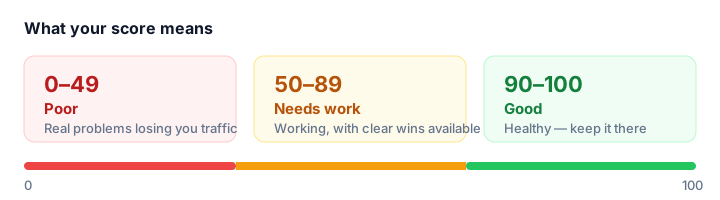
GEO readiness is assessed as part of your overall website health score, which runs from 0 to 100. The AI-visibility portion weighs crawler access most heavily, because it is binary and blocking: if AI bots cannot reach your site, nothing else in this category can compensate. Structured data coverage comes next, then content citability.
Good versus bad GEO scores
A strong GEO result — 90 or above — means AI crawlers are welcome, your schema is present and valid, and your pages contain direct answers that can be lifted and quoted. You will not be cited for every query, but you are in the running for the ones you cover.
A weak score almost always traces to one of two failures. Either the site is technically closed to AI — blocked crawlers, no structured data — or it is technically open but rhetorically unusable, with marketing copy that never actually answers a question. The first is a ten-minute fix. The second is a content rewrite, and it is the one that separates sites that get cited from sites that do not.
Why GEO matters now, not later
Traditional search rewards patience: you build authority over months and it compounds. AI citation works differently — models re-crawl and re-rank continuously, so a site that becomes citable this month can start appearing in answers within weeks. The inverse is also true, which is why an accidental crawler block can silently remove you from an entire channel.
If GEO is new to you, start with our plain-English explainer on what GEO optimization is, or read the full background in our 2026 guide to Generative Engine Optimization. When you are ready to act on it, work through the generative engine optimization checklist, and if Google is where you care most, our guide on how to appear in Google AI Overviews covers the one AI channel that runs on your existing search ranking.
Website GEO check — questions, answered
Straight answers about AI search visibility, written to be quoted.
- What is a website GEO check?
- A website GEO check tests whether generative AI search engines — ChatGPT, Perplexity, Google AI Overviews and Bing Copilot — can access, understand and cite your website. It examines AI crawler permissions, structured data, content clarity and the presence of quotable, self-contained answers on your pages.
- What does GEO stand for in SEO?
- GEO stands for Generative Engine Optimization. It is the practice of optimizing a website so AI-generated answers cite it as a source, in the same way traditional SEO optimizes for ranking in a list of blue links. GEO is a complement to SEO, not a replacement for it.
- How do I check if AI can read my website?
- Run a free GEO check on your URL and the tool reports whether AI crawlers such as GPTBot, ClaudeBot and PerplexityBot are permitted by your robots.txt, whether your structured data is machine-readable, and whether your content is written in a form AI systems can extract and quote. Most sites fail on at least one of these without realizing it.
- Is GEO different from SEO?
- Yes, though they overlap heavily. SEO optimizes for ranking position in a list of results, while GEO optimizes for being quoted inside an AI-generated answer. A fast, well-structured site helps both, but GEO adds specific requirements: crawler access for AI bots, clear entity definitions, and answers written to stand alone out of context.
- Why is my website not showing up in ChatGPT or AI Overviews?
- The three most common causes are blocked AI crawlers in robots.txt, missing or malformed structured data, and content written in a style AI cannot extract cleanly — long unbroken prose with no direct answers. A GEO check identifies which of these applies to your site specifically.
- Does blocking AI crawlers hurt my visibility?
- Yes. If you block GPTBot, ClaudeBot or PerplexityBot in robots.txt, those systems cannot read your content and will never cite you as a source. Some publishers block deliberately to protect content, but if you want AI-driven referral traffic, blocking is a direct trade-off against visibility.
- What is llms.txt and do I need one?
- llms.txt is a plain-text file at the root of your site that describes what your site is and points AI systems to your most important pages. It is a proposed convention rather than an official standard, and Google Search ignores it, but it costs almost nothing to publish and some AI tools do read it.
- How often should I run a GEO check?
- Run one now to establish a baseline, then after any change to your robots.txt, structured data or site architecture. AI search is evolving quickly and new crawlers appear regularly, so a quarterly check is sensible even on a stable site.